Go to Ultimatecarpage.com

Car search: Quick Advanced 
  Ultimatecarpage.com  > Cars by brand  > Great Britain  > Williams
Racing cars  > F1 1980-1989
     FW07B Cosworth
Cars statistics: 3776 cars, 368 makes, 26499 images; Events statistics: 150 reports, 25899 images; Forum statistics: 74,207 members, 37,427 topics; more...


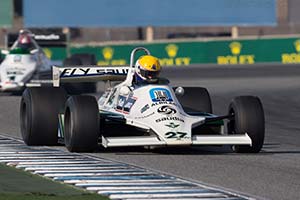
Williams FW07B Cosworth

Williams FW07B Cosworth Williams FW07B Cosworth Williams FW07B Cosworth Williams FW07B Cosworth Williams FW07B Cosworth Williams FW07B Cosworth
Click here to save all images    Image credits: Wouter Melissen 


Model history:
Click here to download printer friendly version Having struggled for survival in Formula 1 for almost a decade, Frank Williams finally received sufficient funding to properly develop and build a top runner. Of the many cars that he entered since 1969, several bore his name, but they were rarely competitive in large part due to the lack of money. By attracting money from the Middle East with sponsors like Saudi Air these problems were solved. In 1977 Williams employed promising young engineer Patrick Head to design a new car for 1978. Dubbed the FW06 and powered by the familiar Cosworth V8 engine, it was used by Alan Jones and Clay Regazzoni in 1978 and in the opening races of 1979. Several points were scored with a second in the US GP by Jones as the best result.

While the FW06 proved quick straight out of the box, it was rendered virtually obsolete when the ground-effects Lotus 79 debuted. By using large underbody venturis and moveable skirts down the side of the car, a low pressure area was created under the Lotus, which produced a massive amount of downforce without any drag penalties. With the FW07 launched in the spring of 1979, Williams also jumped on the ground-effects bandwagon. The monocoque was constructed from an aluminium honeycomb, making it considerably stiffer than that of its predecessor. The suspension was conventional by double wishbones, but the springs were very hard to cope with the huge increase in downforce. The packaged was rounded off by the Cosworth DFV engine.

Even though the car arrived too late to be a force in the championship, and minor problems and accidents hampered the FW07s early in its career, it was immediately obvious that Williams had produced a winner. This promise was fulfilled as Regazzoni scored Williams' first victory in British Grand Prix. Jones continued the good form by winning the German, Austrian, Dutch and Canadian Grands Prix. In this season Lotus struggled and it looked like Head and Williams had moved a step ahead of everybody else in the ground effects territory. People often say that imitation is the biggest complement; Head received several in the following season as many of the smaller British teams copied the basic design of the FW07, but none were executed as well as Williams' original.

Williams was the team to beat in the second half of the season and finished second in the constructor's championship. It was quite remarkable to note that a Williams had never lead a lap before the season in which they scored five victories. Head did not sit still and further developed the underbody and monocoque of the FW07 and Williams started the 1980 season with the FW07B. Regazzoni was replaced by Argentinian Carlos Reutemann. The Jones, Reutemann driver pairing won six Grands Prix and Jones took the driver's championship with his team-mate finishing third. Not surprisingly Williams was crowned constructor's champion at the end of the 1980 season having scored almost three times as much points as the nearest rival.

The championship winning FW07B was carried over for the 1981 and the successful driver pairing was also left unchanged. Reutemann continued the good form with a win in the opening round of the season at Kyalami in South Africa. Changes were required after that race as the sport's governing body decided to ban moveable skirts in an attempt to slow the cars down through the corners. The immediate answer was the Williams FW07C, but the team wasted precious time that season to create an active suspension system that would make sure the fixed skirts were attached to the road at all time. Eventually the team got the car sorted and Williams ended the season with four wins and another constructor's cup. Jones won the last race of the season, which would also be his last Formula 1 race as the 1980 World Champion hung up his helmet at the end of the year.

As had become tradition, the new 1982 Williams did not debute until a few races into the season. Before the FW08 was debuted, two second place finishes were scored with the FW07C. The new car followed the FW07's design, but was more compact and aerodynamically efficient as it was designed specifically for the fixed skirt regulations. Jones' replacement Keijo Rosberg scored just one victory, but in this tragedy struck season, it proved enough to claim the driver's championship. Williams finished in a lowly fourth in the constructor's standings. The reason why the FW08 was so compact became apparent at the end of the season as Williams was caught testing a six-wheeled variant with four rear wheels. Like on the famous Tyrrell P34, the Williams six-wheeler could run smaller wheels that created less drag. Another advantage was the increased length that allowed for large venturi tunnels. It was never raced as the FIA banned six-wheelers starting in 1983.

Dubbed the FW08C, the 1983 Williams looked sufficiently different that it might have warranted a new type indication. A closer look that it was in fact a FW08 stripped of its ground-effects body, which included massive side-pods. The reason for this big change was the complete ban of ground-effects for that season. The cornering speeds achieved were deemed too high, so all cars now featured a flat bottom and small side-pods. Rosberg again scored a single victory, but this time it was nowhere near good enough to claim the driver's title. Williams again finished fourth as the Turbocharged had now really taken over. Having realized this, Williams signed a deal with Honda to supply the British team with their Turbocharged V6 engine for the 1984 season. First tested in the fall of 1983, the Honda engined FW09 would be the beginning of another successful chapter in Williams' history.

Having served the team well for five seasons, Patrick Head's FW07/08 has gone into history as one of the sport's all time greats. The car was instrumental to establish Williams as a serious Formula 1 manufacturer after remaining one of the many F1 kit-car builders that came and went in the 1970s. Especially early in its career there was nothing to match the Cosworth engined FW07s and toward the end of its career the reliability of the package brought the team wins and points that did not seem likely at the start of the race.


Chassis: FW07B / 7
FW07B / 7 This was one of the FW07Bs used by Alan Jones to win the 1980 Formula 1 World Championship. He drove the car to victories in the French and German Grand Prix. In addition he drove chassis FW07B / 7 to wins in the non-championship races in Spain and Jones' native Australia. In later years the car was sold by Williams Engineering complete with a Cosworth DFV engine. The current owner had touring car ace Anthony Reid race the car up the hill at Goodwood in 2008. Reid missed out on the fastest time by a few 1/100 of a second. The World Championship winning Williams is currently being offered through a British dealer.

Article by Wouter Melissen, last updated on 06 / 19 / 2009

Add your comments on the Williams FW07B Cosworth

 Beautiful  
Nagiants40
06-26-2009
This is a very beautiful race car, an era where the most important thing on the tracks are race and win races... great set of photos.
 I saw that car race  
Bullitt5435
06-19-2009
I saw that Williams at the last US GP at Watkins Glen in 1980, and at Montreal in 1981. It was fast and beautiful. At the end of the Watkins Glen race, the teams sold off all of the spare parts they did not want to have to pay to ship back to England. I bought a 3rd gear from one of the Williams transaxles, and still use it as a paperweight.
     
General specifications
Country of origin Great Britain
Chassis number FW07B / 7
Numbers built 7
Produced in 1980

Major wins
1980 Argentine Grand Prix (Alan Jones in FW07B/04)
1980 Monaco Grand Prix (Carlos Reutemann in FW07B/05)
1980 French Grand Prix (Alan Jones in FW07B/07)
1980 British Grand Prix (Alan Jones in FW07B/07)
1980 Canadian Grand Prix (Alan Jones in FW07B/09)
1980 USA Grand Prix (Alan Jones in FW07B/09)

Engine
Configuration Ford Cosworth DFV 90º V 8
Location Mid, longitudinally mounted
Weight 168 kilo / 370.4 lbs
Construction aluminium block and head
Displacement 2.993 liter / 182.6 cu in
Bore / Stroke 85.7 mm (3.4 in) / 64.8 mm (2.6 in)
Compression 11.5:1
Valvetrain 4 valves / cylinder, DOHC
Fuel feed Lucas Fuel Injection
Aspiration Naturally Aspirated

Drivetrain
Chassis/body aluminium monocoque
Suspension (fr/r) doubles wishbones, push-rod actuated coil springs over shock absorbers, anti-roll bar
Steering rack-and-pinion
Brakes ventilated discs, all-round
Gearbox Hewland FGA 400 5 speed Manual
Drive Rear wheel drive

Dimensions
Weight 585 kilo / 1289.7 lbs
Wheelbase / Track (fr/r) 2692 mm (106 in) / 1727 mm (68 in) / 1626 mm (64 in)

Performance figures
Power 485 bhp / 362 KW @ 10750 rpm
Torque 353 Nm / 260 ft lbs @ 9000 rpm
BHP/Liter 162 bhp / liter
Power to weight 0.83 bhp / kg

Resources
Related articles
Useful links


Ultimatecarpage.com - All Cars - Contact us - Privacy Statement - Top © 1998 - 2009 Ultimatecarpage.com