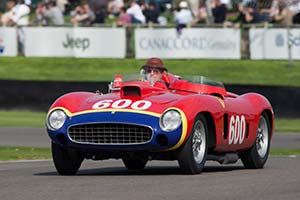
Model history: For the 1956 World Sportscar Championship, Enzo Ferrari increased his odds by fielding both four and twelve cylinder engined versions of the same car, dubbed the 860 Monza and 290 MM respectively. Both engines had a similar 3.5 litre displacement; the straight four had the benefit of an abundance of low-end torque while the V12 produced more horsepower at high revs. The two models shared the latest 'Tipo 520' sports car chassis and were clothed by Scaglietti with similar aluminium bodies.
Ahead of the introduction of the new models, Ferrari started the Championship in Buenos Aires with the existing 410 S. The two entered cars failed miserably in the race dominated by arch-rival Maserati but all was forgotten when the 860 Monza made a very successful debut in the Sebring 12 Hours; the two cars entered finished first and second. Round three was the all important Mille Miglia where Ferrari entered two of the appropriately named 290 MMs, backed up by a duo of 860 Monzas.
The Tipo 520 chassis used for both cars was an evolution of the Tipo 510 chassis found in the four-cylinder engined cars of 1955. Like all of its predecessors, the chassis was still constructed from two large oval tubes but also used more small-diameter tubes for added strength than ever before. In many ways it was one of Ferrari's first takes on the emerging spaceframe type chassis. Suspension at the front was by double wishbones, while the rear-end featured a DeDion axle.
The 290 MM's Tipo 130 engine was a development of the familiar Colombo 'short-block' V12. Responsible for the new engine was a trio of engineers, who worked under the supervision of the great Vittorio Jano, who had recently joined Ferrari from Lancia. Compared to the more familiar 3-litre version of Colombo's V12, the Tipo 130 featured a longer stroke and twin-plugs per cylinder. Breathing through three quad-choke Weber carburettors, the 3.5 litre engine produced around 320 bhp at well over 7000 rpm. The similarly sized 860 Monza 'four' put out a more modest 280 bhp.
The four Works Ferraris were piloted by the Scuderia's F1 drivers, Juan Manuel Fangio, Luigi Musso, Eugenio Castellotti and Peter Collins The four and twelve cylinder cars could be distinguished by the bonnet blisters; the 860 Monza sported two smaller ones to clear the twin-cam engine while the 290 MM had a single, tall intake for the big Webers. Not surprisingly the Ferraris reigned supreme with Castellotti taking the win in his 290 MM ahead of Collins and Musso in 860 Monzas and Fangio in the other V12-engined car. Olivier Gendebien completed the top five in a Ferrari 250 GT.
For the 24 Hours of Le Mans, which was not part of the Championship this season, Ferrari decided to use the four cylinder 625 LMs. At the Nurburgring 1000 km, a Maserati 300 S won again but with a second for a 860 Monza and a third for a 290 MM, Ferrari did manage to score valuable points. The Italian team returned to their winning ways during the final round in Sweden. Phil Hill and Maurice Trintignant won handsomely in a 290 MM ahead of Wolfgang von Trips and Peter Collins in a sister car. A 860 Monza finished third and two privately entered Ferraris filled fourth and fifth. With three wins in five races, Ferrari was deservedly crowned World Champion.
Under Jano's supervision the V12 engine was developed further and for 1957 received twin-overhead camshafts in the Works 290 S, 315 S and 335 S models. The now redundant 290 MMs were sold to privateers. Temple Buell's quasi-works entry in the season opening Buenos Aires 1000 km race resulted in yet another victory for the 3.5 litre V12 engined machine. Later in the year Stirling Moss celebrated his first successes with a Ferrari sports racer by taking two wins during the popular Nassau Speed Week. The 290 MM to take these 1957 wins had originally been conceived as an 860 Monza. Three of each were built and five have survived.
Chassis: 0616
The second of four 290 MMs built, chassis 0616 was driven to a debut victory in the 1956 Mille Miglia by Eugenio Castellotti. It subsequently failed to finish at the Nürburgring and did not start the Targa Florio after an accident in practice. After its brief Works career, it was sold to an American privateer who raced it at Le Mans and several other events in 1957 but with little luck. The Mille Miglia winning car remained in the US and has been owned by the same collector since 1995. He is seen here in action during the 2004 Monterey Historic Races.
Chassis: 0626
Chassis 0626 made its debut at the 1956 Mille Miglia in the hands of Juan Manuel Fangio, who always usually competed in the great road race alone. He finished fourth behind the three other Tipo 520 Ferraris. In the remainder of the season, this example recorded two more podium finishes. Entered by American Temple Buell but piloted by Ferrari Works drivers, chassis 0626 won the 1957 Buenos Aires 1000 km race. It was used extensively that season by the likes of Jo Bonnier and Masten Gregory but no more wins were scored. After changing hands several times, this 290 MM joined the impressive Mas du Clos Collection in 1970. The current owner acquired the car from the collection in 2004 and is seen here during the 2006 Goodwood Revival where the career of Phil Hill was celebrated.
Chassis: 0628
Serial number 0628 was the sixth and final Tipo 520 chassis built. It was originally fitted with the 860 Monza four-cylinder engine and used by the Works team throughout 1956. The best result that year was a second in the Mille Miglia behind the victorious 290 MM and a third in the Targa Florio. For 1957 a Tipo 130 V12 engine was fitted, transforming the car into a 290 MM. After two more Works outings it was sold to Jan de Vroom in New York. The was subsequently damaged in an accident and rebuilt by the factory with a pontoon-fender nose similar to the latest 250 TRs. In this guise Stirling Moss drove 0628 to two wins at Nassau.
After its retirement the well raced 290 MM remained in the United States and was eventually acquired by Luigi Chinetti. He held on the car for nearly three decades before selling the car to Jon Shirley. He had Butch Dennison and Pete Lovely restore the car to its early 1957 configuration in which it had raced at Buenos Aires and Sebring. After the restoration, it was shown at all the major American shows and awarded numerous awards, including the much coveted Best in Class at Pebble Beach. In 2006 it was offered as a private treaty by Gooding and eventually found a new home in 2007.