
| sport |
 Ultimatecarpage.com
> Cars by brand
> Italy
> Ferrari
Ultimatecarpage.com
> Cars by brand
> Italy
> Ferrari
 Racing cars
> Other Sportscars 860 Monza Racing cars
> Other Sportscars 860 Monza
|
| Ferrari 860 Monza |
| Article | Image gallery (32) | Chassis (2) | Specifications | User Comments (3) |
|
|
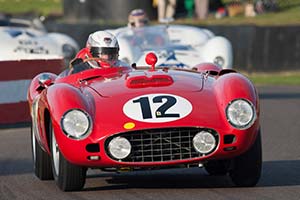
Page 1 of 1  Originally developed for the all-conquering Ferrari 500 F2 single seater, the Aurelio Lampredi designed straight four was briefly among Ferrari's most widely used sports car engines during the early 1950s. Following several prototypes raced by the works team in 1953, two production racers were launched in 1954; the 500 Mondial and 750 Monza, equipped with respectively a two- and three-litre version of the 'four'. Originally developed for the all-conquering Ferrari 500 F2 single seater, the Aurelio Lampredi designed straight four was briefly among Ferrari's most widely used sports car engines during the early 1950s. Following several prototypes raced by the works team in 1953, two production racers were launched in 1954; the 500 Mondial and 750 Monza, equipped with respectively a two- and three-litre version of the 'four'.In a quest for even more power and torque, Ferrari's engineers continued the development of the four-cylinder engine. By 1955 its maximum displacement of just over 3.4 litre was achieved by boring and stroking the light alloy block to 102 mm and 105 mm respectively. That was almost twice the size of the two-litre original, which featured a more modest bore and stroke of 90 mm and 78 mm. The big 'four' a unitary displacement of 857.98 cc. Known as the 'Tipo 129', the 1955 specification engine did follow the design of Lampredi's original, first raced back in 1952. Both the block and head were constructed from light alloy. The beautifully sculpted head featured twin overhead camshafts and could accommodate for two plugs per cylinder. The engine was fed by two massive twin-choke Weber carburettors. All this helped the Tipo 129 produce around 280 bhp and close to 400 Nm of torque. Mated to a five-speed gearbox, the very tall engine was bolted in the Tipo 510 chassis that was virtually identical to the one used for the 750 Monza production cars. The frame was constructed from elliptical tubes and suspension was by double wishbones and coil springs at the front, while the rear used a DeDion axle with a transverse leaf spring. Unlike the British rivals, the Italian manufacturer opted to retain the tried and test hydraulic drums over the disc brakes pioneered by Jaguar. In good Ferrari tradition, the new four cylinder racer was named after its unitary displacement, so the car was known as the 857 S or Sport. From the Ferrari factory, the rolling chassis were shipped to Sergio Scaglietti in Modena, who by then was responsible for clothing almost all of Ferrari's sports racers. The aluminium skin crafted by Scaglietti's skilled workers was similar to that of the rest of the range with the exception of two 'blisters' on the engine cover, needed to clear the tall engine's cam covers. Especially for the Scuderia Ferrari works team, three examples were produced late in 1955, while a fourth 857 Sport was sold directly to the United States. The three works cars were raced only briefly by the factory with a victory in the Giro di Sicilia in 1956 as the best result. In private hands the four machines were campaigned for a lot longer and with considerable success, especially in the United States. Among the 857 Sport's noteworthy drivers were the likes of Phil Hill and Carroll Shelby. One of the main reasons the 857 Sport was only briefly used by the Scuderia was that it was quickly followed by the 860 Monza. This used the same Tipo 129 engine but now in combination with the Tipo 520 chassis also used by the V12-engined 290 MM. Compared to the earlier design, the new chassis featured tubular reinforcements bringing it closer to a 'spaceframe' design. Another change was the adoption of a sturdier four-speed gearbox. Only three 860 Monzas were built, one of which was later converted to 290 MM specification. Ready in time for the season opening Sebring 12 Hours, the new 860 Monza had a dream debut. Two cars were entered and Fangio and Castellotti led Musso and Schell home to score a one-two win. The winning car was sold but the other was campaigned alongside the 290 MMs for the rest of the year. Schell added another victory to the 860 Monza's tally by winning the GP de Rouen. The 1956 season would be the swansong for the works four cylinders but the engine would live on for another year in the customer 500 TR (C). Used with great effect in period, the four-cylinder engines form but a side-note in the history of Ferrari where the V12 engine reigns supreme. When driven well, and most importantly carefully, the four-cylinder Ferraris were more than a match for most rivals. However, missing a gear and over-revving could have catastrophic results. It is perhaps not a coincidence then that the type's biggest win was scored by the ever delicate Juan Manuel Fangio. Page 1 of 1 |
| Article | Image gallery (32) | Chassis (2) | Specifications | User Comments (3) |
| All Cars - Contact us - Privacy Statement - Top | © 1998 - 2026 Ultimatecarpage.com |