Go to Ultimatecarpage.com

Car search: Quick Advanced 
  Ultimatecarpage.com  > Cars by brand  > Great Britain  > McLaren
Racing cars  > F1 1980-1989
     MP4/4 Honda
Cars statistics: 3761 cars, 363 makes, 26312 images; Events statistics: 150 reports, 25899 images; Forum statistics: 73,922 members, 37,328 topics; more...


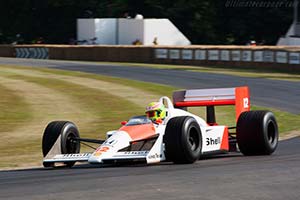
McLaren MP4/4 Honda

McLaren MP4/4 Honda McLaren MP4/4 Honda McLaren MP4/4 Honda McLaren MP4/4 Honda
Click here to save all images    Image credits: Wouter Melissen 


Click here to download printer friendly version Despite the dismal results achieved with the low-line Brabham BT55 in 1986, designer Gordon Murray was given carte-blanche by McLaren to give it another go a year later. This time round the results were a complete mirror image. Drivers Ayrton Senna and Alain Prost together won 15 of the 16 races in the 1988 season, making Murray's ultra-low MP4/4 one of the most successful racing cars ever built.

In theory Murray's objective of placing all of the car's weight as low as possible in the chassis made perfect sense. With the Brabham that meant placing the BMW four-cylinder engine at a sharp angle, which created all sorts of problems. The very compact Honda V6 used by McLaren was much more suited to this purpose. The ultra-low chassis meant that the drivers had to lie almost flat in the car, which was something Alain Prost initially objected to.

Although the packaging and execution was very different, the specifications of the chassis, penned by Murray in conjuction with Steve Nichols, very much followed convention. At the core was a carbon fiber / honeycomb monocoque suspended by double wishbones on both ends. At the front push-rods actuated the springs/damper units while at the rear rocker-arms were used. Carbon ceramic disc brakes were used on all four wheels.

In addition to the obvious handling benefits, the low line also provided aerodynamic advantages. The frontal area was reduced by 10% and air could flow more cleanly to the rear wing, greatly improving its efficiency. Murray's only compromise concerned the ride-height, which was not quite as low as it could have been to get . This made the MP4/4 more forgiving to drive and easier to setup.

The TAG/Porsche V6 that had brought three World Championships was replaced by the superior twin-turbo Honda V6, which had been used to great effect by the Williams and Lotus teams. Even with the latest boost-restrictions, it was the most powerful engine on the grid. The V6 was mated to a three-shaft six-speed gearbox that was specifically developed for the MP4/4 in conjuction with Weisman in the USA.

Brazilian rising star Ayrton Senna had moved with the Honda engines from Lotus to McLaren. His raw speed complemented the then two-time World Champion Alain Prost. The French driver had earned the nickname 'Le Professeur' for his consistent and smooth driving style. The two best drivers on the grid, Murray's ultra-low chassis and the most powerful engine made for an unbeatable combination.

Regardless of the strength of the car and driver, Formula 1 remains a mechanical sport where anything can happen. Amazingly problems only occurred for both drivers in the Italian Grand Prix at Monza where Prost was forced to retire with engine problems and Senna hit a back-marker in the closing stages. One week after Enzo Ferrari's death it was fitting that the home Grand Prix was won by Gerhard Berger in a Ferrari.

In the other fifteen races of the season, the McLarens were unstoppable. Senna had the edge with 13 pole positions and 8 victories. His teammate won the other 7 and scored 11 more points. However only the 11 best results of the year counted, so Senna was crowned Champion with a 3-point lead over Prost. Berger was a further 46 points adrift. Needless to say McLaren won the Constructor's Championship with nearly three times as many points as runner-up Ferrari.

The remarkable MP4/4 had to be retired at the end of the season as for 1989 turbocharged engines were banned. Having proven his point in rather dramatic fashion, Murray was assigned to the new road car program. Under a new designer and with a new Honda engine McLaren's dominance continued. The results and ultra-low appearance of the MP4/4 were however never matched. It remains as the best Grand Prix car ever built by McLaren.

Article by Wouter Melissen, last updated on 06 / 24 / 2009

Add your comments on the McLaren MP4/4 Honda


General specifications
Country of origin Great Britain
Numbers built 6
Produced in 1988
Body design Gordon Murray

Major wins
  • 1988 Brazilian Grand Prix (Alain Prost in MP4/4 - 2)
  • 1988 San Marino Grand Prix (Ayrton Senna in MP4/4 - 1)
  • 1988 Monaco Grand Prix (Alain Prost in MP4/4 - 4)
  • 1988 Mexican Grand Prix (Alain Prost in MP4/4 - 4)
  • 1988 Canadian Grand Prix (Ayrton Senna in MP4/4 - 1)
  • 1988 Detroit Grand Prix (Ayrton Senna in MP4/4 - 2)
  • 1988 French Grand Prix (Alain Prost in MP4/4 - 4)
  • 1988 British Grand Prix (Ayrton Senna in MP4/4 - 5)
  • 1988 German Grand Prix (Ayrton Senna in MP4/4 - 5)
  • 1988 Hungarian Grand Prix (Ayrton Senna in MP4/4 - 5)
  • 1988 Belgian Grand Prix (Ayrton Senna in MP4/4 - 5)
  • 1988 Portuguese Grand Prix (Alain Prost in MP4/4 - 6)
  • 1988 Spanish Grand Prix (Alain Prost in MP4/4 - 6)
  • 1988 Japanese Grand Prix (Ayrton Senna in MP4/4 - 2)
  • 1988 Australian Grand Prix (Alain Prost in MP4/4 - 6)

Engine
Configuration Honda RA186-E 80º V 6
Location Mid, longitudinally mounted
Construction aluminium alloy block and head
Displacement 1.494 liter / 91.2 cu in
Valvetrain 4 valves / cylinder, DOHC
Fuel feed Honda Fuel Injection
Aspiration 2 IHI Turbos

Drivetrain
Chassis/body carbon fibre honeycomb monocoque
Front suspension double wishbones, push-rod actuated coil springs and dampers
Rear suspension double wishbones, rocker-arm actuated coil springs and dampers
Brakes carbon ceramic discs, all-round
Gearbox McLaren 6 speed Manual
Drive Rear wheel drive

Dimensions
Weight 540 kilo / 1190.5 lbs
Length / Width / Height 4394 mm (173 in) / 2134 mm (84 in) / 940 mm (37 in)
Wheelbase / Track (fr/r) 2875 mm (113.2 in) / 1824 mm (71.8 in) / 1670 mm (65.7 in)

Performance figures
Power 900 bhp / 671 KW
BHP/Liter 602 bhp / liter
Power to weight 1.67 bhp / kg

Resources
Suggested reading McLaren, the Grand Prix, Can-Am and Indy Cars, Doug Nye
McLaren - The cars 1964 - 2008, by William Taylor
Useful links


Ultimatecarpage.com - All Cars - Contact us - Privacy Statement - Top © 1998 - 2009 Ultimatecarpage.com