Page 1 of 1 In 1962 Carroll Shelby dramatically changed American road racing by unleashing the legendary Cobra. Up until that year the SCCA production class was mainly dominated by Corvettes modified in the drivers' backyards. The three major American manufacturers, united in the AMA, had agreed not to race in the late 1950s, so there were no Works teams. Shelby quietly received backdoor support from Ford, who threaded very carefully not to the break the AMA agreement. Bill Thomas, one of the Corvette racing car builders, approached General Motors with a request for support to build a competitor for the Cobra using Corvette mechanicals. His idea was well received and Thomas went ahead to start the development of the 'Cheetah'. There was one major hump in the road ahead as at least 100 examples were going to have to be produced before the Cheetah could race in the Cobra's class in SCCA sanctioned events.
Thomas took the Corvette small-block V8 engine as the starting point for the project. He stroked to displace well over 6 litres and fitted it with his own development of the Rochester Fuel Injection. He claimed an output of well over 500 bhp for a properly sorted engine. Inspired by the latest European racing cars, Thomas opted for a spaceframe type chassis consisting of a large number of small diameter tubes. The engine was mounted very far back in the chassis to get a perfect weight balance. With the passenger compartment also moved back, it meant that the driver pretty much sat on top of the independent rear suspension. As Thomas was restricted to Corvette parts, he had to use drum brakes, which would turn out to be a real handicap. The Cheetah was covered in a stylish Coupe body crafted from aluminium. Access was through gull-wing doors, which were attached to the roll cage.
After some delays, the first example was ready towards the end of 1963 and it seemed unlikely that the 100 car production run would be completed before the 1964 season would start. With a 200 kg and 150 bhp advantage over the small-block Cobras the Cheetah would form a real threat. Sadly nowhere near enough examples were produced and Thomas' creation had to race in the specials class against the mid-engined sports racers like the Chaparral 2A. Once the completed cars hit the track, the competition was the least of the drivers' worries. More immediate problems included the doors blowing off at speed as well as the cockpit turning into a very hot sauna. At least one car was raced with the roof chopped off. Nevertheless, the Cheetahs managed to score eleven victories in minor races and proved to be remarkably competitive against the altogether more advanced mid-engined racers.
Things got even more complicated for 1965 as the SCCA announced the production limit for the GT class would be raised from 100 to 1000 cars. To add insult to injury, Thomas' small factory was damaged in a fire and production ground to a standstill. Thomas pulled the plug on the project not much later. In the end only around a dozen examples of the Cheetah were produced. In the following years several companies offered kit-cars 'inspired' by the Cheetah. Of the 29 road and racing cars built, only 14 have survived. Despite its lack of racing success the Cheetah is much sought after today. Page 1 of 1

 Ultimatecarpage.com
> Cars by brand
> United States
> Cheetah
Ultimatecarpage.com
> Cars by brand
> United States
> Cheetah
 Racing cars
> GT Cars
Racing cars
> GT Cars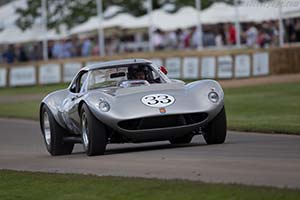
 In 1962 Carroll Shelby dramatically changed American road racing by unleashing the legendary Cobra. Up until that year the SCCA production class was mainly dominated by Corvettes modified in the drivers' backyards. The three major American manufacturers, united in the AMA, had agreed not to race in the late 1950s, so there were no Works teams. Shelby quietly received backdoor support from Ford, who threaded very carefully not to the break the AMA agreement. Bill Thomas, one of the Corvette racing car builders, approached General Motors with a request for support to build a competitor for the Cobra using Corvette mechanicals. His idea was well received and Thomas went ahead to start the development of the 'Cheetah'. There was one major hump in the road ahead as at least 100 examples were going to have to be produced before the Cheetah could race in the Cobra's class in SCCA sanctioned events.