Page 1 of 2 Next >> A golden age for American road racing dawned in the second half of the 1950s. The V8 engined 'backyard specials' were quickly replaced by purpose built sports cars, which were predominantly sourced from Europe. The 1958 season was expected to be particularly competitive as revised regulations left all big-engined racing cars obsolete for major international races like the 24 Hours of Le Mans. Many of these cars were not ready for retirement and found their way into the hands of American racing drivers. Going against the grain, the young heir to the Woolworth fortune Lance Reventlow decided to build his own car instead. Together with his friend Bruce Kessler he had toured various European factories in 1957 and concluded that he had seen nothing that could not be done in the United States. He was just 21 years of age at the time.
To ensure his new machine would be up to the challenge, Reventlow had his chief mechanic Warren Olson hire the best designers and builders. Among them were former Kurtis fabricators Dick Troutman and Tom Barnes, and engine wizards Jim Travers and Frank Coon, who would later form Traco. Reventlow also called in the help of legendary racer and designer Ken Miles to draft up the chassis. The final piece of the puzzle was Chuck Daigh, who was hired as both as a driver and a drivetrain specialist. Reventlow Automobiles Incorporated was led by Olson and set up shop in North Hollywood, California. Within months after assembling the engineering 'dream team' the first sports racer rolled out of the shop. Reventlow dubbed it the 'Scarab' after a dung beetle that was considered sacred in Ancient Egypt.
Reventlow had one big advantage over the Europe sourced competition; he could build a car specifically for American 'stop-go' tracks, which were quite different than their much faster European counterparts. Accordingly he asked for a car that was compact, light and above all able to put its power down very well. Inspired by the Mercedes-Benz 300 SL, Miles penned a design for a spaceframe with enough room for Olson and his men to make their own interpretations. The suspension was equally advanced through double wishbones at the front and DeDion axle at the rear. Making an all American racing car meant that Reventlow had to make a compromise and use drum brakes instead of the superior British discs. The only 'inconsistency' was the Morris sourced rack-and-pinion steering box.
The very American Corvette V8 formed the basis for the Scarab's powerplant. Although by the time Travers and Coon were done with the engine, it was a different beast altogether. The first order of business was to increase displacement from the original 4.6 litre (283cid) to 5.5 litre (339cid) by boring and stroking the V8. The enlarged engine was equipped with Hilborn Fuel Injection and the intake manifold sported eight very stylish intake trumpets. With all modifications in place, the V8 was good for anywhere between 360 and 385 bhp, most of which was available from very low revs. The engine was mated to a Borg-Warner four-speed gearbox, which had an aluminium casing. An aluminium body styled by 19-year old Art Center School student Chuck Pelly, rounded off the package. The completed machine weighed in at a very competitive 860 kg or 1900 pounds. Page 1 of 2 Next >>

 Ultimatecarpage.com
> Cars by brand
> United States
> Scarab
Ultimatecarpage.com
> Cars by brand
> United States
> Scarab
 Racing cars
> Other Sportscars
Racing cars
> Other Sportscars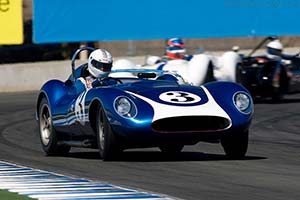
 A golden age for American road racing dawned in the second half of the 1950s. The V8 engined 'backyard specials' were quickly replaced by purpose built sports cars, which were predominantly sourced from Europe. The 1958 season was expected to be particularly competitive as revised regulations left all big-engined racing cars obsolete for major international races like the 24 Hours of Le Mans. Many of these cars were not ready for retirement and found their way into the hands of American racing drivers. Going against the grain, the young heir to the Woolworth fortune Lance Reventlow decided to build his own car instead. Together with his friend Bruce Kessler he had toured various European factories in 1957 and concluded that he had seen nothing that could not be done in the United States. He was just 21 years of age at the time.