Page 1 of 2 Next >> Ferrari's first production racing car, the 166 MM, was introduced late in 1948. In the following years the model evolved into the 195 Sport, 212 Export, 225 Sport and finally the 250 MM. For anyone familiar with Ferrari nomenclature, it will not come as a surprise that each of these cars had a slightly larger version of the Colombo V12 engine. Starting in the 166 MM at a discplament of 2 litre (a unitary displacement of 166 cc), the engine grew in size to 3 litre (250 cc) within five years. The chassis remained virtually unchanged, while the various coachbuilders added plenty of variety.
The origins of the single overhead camshaft engine lay with designs penned by Gioacchino Colombo way back in 1946. With Grand Prix racing in mind the initial displacement was just 1500 cc. In Naturally Aspirated form the big successes came once the V12 was enlarged to two litres with victories at Le Mans and in the Mille Miglia. This gain in cylinder size was achieved by increasing both the bore and the stroke to 60 mm and 58.8 mm respectively. The bore would grow further, but the stroke remained the same in all future applications of the Colombo engine.
The first evolution came in 1950 with the displacement lifted to 2.3 litre on four existing 166 MMs to create the 195 S. The following year the bore was raised to 68 mm for a swept volume of just under 2.6 litre. Fitted to the 212 Export chassis, it was good for a healthy 150 bhp. A total of 27 examples were constructed and during the year a shift in favoured coachbuilder became apparent. All but five of the 166 MMs were bodied by Touring, yet less the Milanese carrozzeria worked on less than half of the 212s. Vignale of Turin handled as many cars as Touring and that trend would continue with the next customer racing Ferrari. Page 1 of 2 Next >>

 Ultimatecarpage.com
> Cars by brand
> Italy
> Ferrari
Ultimatecarpage.com
> Cars by brand
> Italy
> Ferrari
 Racing cars
> Other Sportscars
Racing cars
> Other Sportscars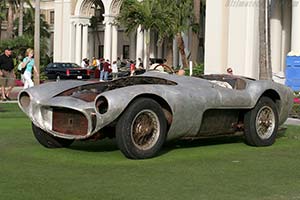
 Ferrari's first production racing car, the 166 MM, was introduced late in 1948. In the following years the model evolved into the 195 Sport, 212 Export, 225 Sport and finally the 250 MM. For anyone familiar with Ferrari nomenclature, it will not come as a surprise that each of these cars had a slightly larger version of the Colombo V12 engine. Starting in the 166 MM at a discplament of 2 litre (a unitary displacement of 166 cc), the engine grew in size to 3 litre (250 cc) within five years. The chassis remained virtually unchanged, while the various coachbuilders added plenty of variety.