Go to Ultimatecarpage.com

Car search: Quick Advanced 
  Ultimatecarpage.com  > Cars by brand  > Great Britain  > Sunbeam
Racing cars  > Pre 1950 GP
     2-Litre Grand Prix
Cars statistics: 3761 cars, 363 makes, 26312 images; Events statistics: 150 reports, 25899 images; Forum statistics: 73,922 members, 37,328 topics; more...


Sunbeam 2-Litre Grand Prix

Sunbeam 2-Litre Grand Prix Sunbeam 2-Litre Grand Prix Sunbeam 2-Litre Grand Prix Sunbeam 2-Litre Grand Prix Sunbeam 2-Litre Grand Prix Sunbeam 2-Litre Grand Prix
Click here to save all images    Image credits: Wouter Melissen 


Model history:
Click here to download printer friendly version Sunbeam Talbot Darracq's chief engineer Louis Coatalen figured the easiest route to Grand Prix racing glory was to employ the most successful designer of the time. This was Swiss engineer Ernest Henry, who had previously been responsible for the engines in the fantastic Peugeot and Ballot racing cars. He was hired in time to develop a Sunbeam Grand Prix car from scratch for the 1922 season. The reason for the clean sheet was a regulation change that saw the maximum engine displacement drop from three to just two liter for the next three seasons.

Henry drew up a long stroke four-cylinder engine with a fixed block and head. Just like on his earlier designs, the head featured two camshafts and four valves per cylinder. Each cylinder was also equipped with twin spark plugs to optimize combustion. Breathing through two Solex carburetors, Henry's new four cylinder engine produced a commendable 88 bhp. Mated to a three speed gearbox, it was mounted in a relatively straightforward ladder frame with underslung solid axles on both ends. The drum brakes used Hispano Suiza patented servo assistance that was driven from the gearbox.

While Henry did most of the design work at the old Darracq works in Suresnes, France, the actual assembly of the new Grand Prix cars was done in the Wolverhampton, England based Sunbeam factory. A total of four cars were completed, draped in very narrow but elegant Grand Prix bodies. One of the more striking features was the spare wheel that was mounted longitudinally in the long tail. Ahead of the all important French Grand Prix in Strasbourg, the first completed example was tested at Brooklands and in the Tourist Trophy race on the Isle of Man.

Assigned to drive the first car on the Isle of Man was Kenelm Lee Guinness. He proved to be as fast as the earlier three-litre, eight cylinder Sunbeams that were actually entered in the race. One of those 'TT Sunbeams' won the race in the hands of Jean Chassagne and Robert Laly. Impressed by the pace displayed against larger engined machinery, Coatalen decided to send all four of the new Sunbeam Grand Prix cars to Strasbourg for the French Grand Prix. Guinness and Chassagne were joined for the occasion by Henry de Hane Segrave.

Practice went far from easy for the Sunbeam team; the cars struggled to keep up with the new six-cylinder Fiats and the example driven by Segrave suffered a cracked crankcase. That was the result of an excessive amount of hot water was poured over the hot engine block, which was called in after a carburetor fire. Fortunately the team had brought all four cars, so Segrave could start the race in the spare. To bridge the gap with the Fiats, slightly shorter gears were fitted. This in turn caused the engines to over-rev during the race, resulting in cracked inlet-valves on all three engines. In a real race of attrition the sole surviving Fiat of Felice Navarro finished a whole hour ahead of the second placed Bugatti.

The four Grand Prix cars were repaired back in Wolverhampton and subsequently sold to privateers. Coatalen had acquired the services of former Fiat engineers Vincenzo Bertarione and Walter Becchia, who built a green version of the six-cylinder Fiat for the 1923 season. This time round Sunbeam was successful and won the French Grand Prix. Amazingly all four of the 1922 Sunbeam Grand Prix cars survive to this day, although there is ongoing discussion about exactly which car was driven by whom in period. Although not particularly successful, the 1922 version is considered the best looking of the Sunbeam Grand Prix cars.


Chassis: 2
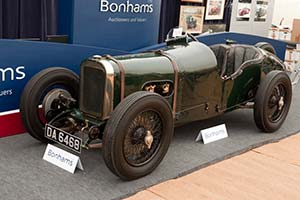
2 Still subject of debate but chassis 2 or 2.22 is believed to be the car that suffered the cracked crankcase in the French Grand Prix at Strasbourg. The car did not resurface until after the War. Still in highly original condition, it was actively campaigned in the 1950s and 60s until it was acquired by the current owner in 1968. After 40 years of inactivity the rare Sunbeam Grand Prix was offered at the 2009 Bonhams Goodwood Festival of Speed auction. Estimated to sell for £300,000 - £400,000, it eventually found a new owner for £463,500 despite not being in full running order. (Source: Bonhams)

Chassis: 4
4 This is believed to be the fourth and final 1922 Sunbeam Grand Prix car constructed. Unlike its sister cars, it did not receive a registration number, which may indicate it was the spare car. At one point in its history, it was fitted with the DA 6436 registration number and 21 racing number, which were originally applied to the first chassis. In full running order, it is seen here at the 2008 Goodwood Festival Speed. (Source: The Strasbourg Sunbeams, by Neville S. Webb)

Article by Wouter Melissen, last updated on 07 / 16 / 2009

Add your comments on the Sunbeam 2-Litre Grand Prix


General specifications
Country of origin Great Britain
Chassis number 2 / 4
Numbers built 4
Produced in 1922

Engine
Configuration Straight 4
Location Front, longitudinally mounted
Construction cast-iron block and head
Displacement 2 liter / 122 cu in
Valvetrain 4 valves / cylinder, DOHC
Fuel feed 2 Solex Carburettors
Aspiration Naturally Aspirated

Drivetrain
Chassis/body steel ladder frame
Front suspension solid axle, semi-elliptic leaf springs, Hartford friction dampers
Rear suspension live axle, semi-elliptic leaf springs, Hartford friction dampers
Brakes servo assisted, cable operated drums, all-round
Gearbox 3 speed Manual
Drive Rear wheel drive

Performance figures
Power 88 bhp / 66 KW @ 4200 rpm
BHP/Liter 44 bhp / liter

Resources
Suggested reading The Strasbourg Sunbeams, by Neville S. Webb
Related articles
Useful links


Ultimatecarpage.com - All Cars - Contact us - Privacy Statement - Top © 1998 - 2009 Ultimatecarpage.com