Page 1 of 3 Next >> For Porsche racing has always been part sport and part business. The German manufacturer does not only race to sell cars, but also sells their racing cars to customers. The extensive rule changes before the 1982 season worked out particularly well for Porsche. The elaborate Group 1 through 7 classes were replaced by just three 'groups'; A through C. Group C for one-off prototype sports racers was pretty much written with Porsche in mind and with the 956 and subsequent 962 the German manufacturer dominated endurance racing. Group A was intended for high volume family saloons, so there was no business there for Porsche. The Group B class, which would be used for the World Rally Championship, was under scrutiny from Porsche's engineers. They felt that only a purpose built rally car could be competitive. One of the big stumbling blocks was the minimum production requirement of 200 units within in 12 months. There was no way that Porsche could find that many customers for a rally car, so the project was put on hold. The focus was instead on the 956 Group C racer and a Group B rally car based on the 911 SC road car.
Group B proved to be hugely popular with the likes of Audi and Lancia campaigning rally cars that were packed with the latest technology. They had met the homologation requirements by simply building 200 thinly disguised road versions of their rally racers. Not surprisingly a Porsche Group B car was considered once again early in 1983. Porsche's competition department reasoned that the technology required for the rally car could later be used on the production cars. Their ideal Group B car featured a mid mounted engine, four wheel drive and the 'PDK' dual clutch system. Eventually a compromise was agreed upon, which did include four wheel drive, but with a traditional gearbox and rear mounted engine. Quite in contrast with their competitors, Porsche decided to develop the new Group B racer as a road car first. The very high performance 'super Porsche' would propel the German manufacturer into the supercar ranks and ensure that the minimum number of 200 cars could be built and most importantly sold. Work on project '959' started in the spring of 1983 and production was planned to start early in 1985. The designers estimated the 959 would be priced at DM 150,000, which would make it the most expensive Porsche ever built.
By using the basic 911 monocoque, the Porsche engineers had something familiar to start with. Much of the early work focused on the four wheel drive system, with which the Porsche engineers had very limited experience. Various systems were tested in combination with different suspension types. The hardware of the Porsche four wheel drive system was fairly straightforward; the real beauty lay in the software. The system was equipped with a computer that controlled the amount of drive to the front wheels, through a 'PSK' clutch fitted between the gearbox and the front differential. It compensated, for example, for the weight shift during acceleration. The driver was also given four settings to manually control the power sent to the front wheels in extreme conditions like ice or snow. The engineers also found that the four wheel drive system worked best with double wishbone front suspension instead of the McPherson struts normally found on a 911. To ensure that the front wheels had traction at all times, each side was fitted with twin coil spring over damper units. The rear suspension also consisted of double wishbones, however with just one coil/damper combo and an additional damper on each side. With its potential rally career in mind, the 959 chassis was equipped with four different mounting points for each wishbone to adjust the ride height. The pressure in the dampers could be adjusted from the cockpit.
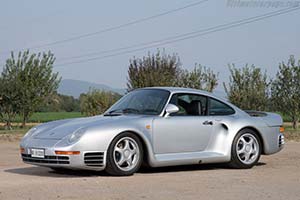
While the four wheel drive system was still under scrutiny, attention was shifted to the exterior styling. Porsche was eager to show a preview of the company's new Group B contender at the upcoming Frankfurt (IAA) show in September of 1983. The styling of the fully equipped, but non-running 'Gruppe B' concept shown in Frankfurt differed only in detail from the production 959. Apart from the shell very little from the 911 body was carried over. Light weight and low drag were top priorities for the designers and to complicate things further, the Porsche 911 shape had to be retained. They succeeded remarkably well to include the key features of the original 911 launched exactly 20 years earlier into a much wider and smoother body. The new shape was quite a departure from the contemporary 911 range and would form the basis for future 911 generations. The designers had hoped to get away with a wingless design, but wind tunnel tests showed that the rear end could not do without. They came up with a very elegant integrated rear wing. Thanks to a fully enveloping underbody the drag figure was kept down to a very competitive 0.32. All of the panels were crafted from either aluminium alloy or composite materials like Kevlar. The Kevlar panels were reinforced by steel frames. Even the 911 derived steel roof was replaced by a light weight plastic example. Page 1 of 3 Next >>

 Ultimatecarpage.com
> Cars by brand
> Germany
> Porsche
Ultimatecarpage.com
> Cars by brand
> Germany
> Porsche
 959
959
 For Porsche racing has always been part sport and part business. The German manufacturer does not only race to sell cars, but also sells their racing cars to customers. The extensive rule changes before the 1982 season worked out particularly well for Porsche. The elaborate Group 1 through 7 classes were replaced by just three 'groups'; A through C. Group C for one-off prototype sports racers was pretty much written with Porsche in mind and with the 956 and subsequent 962 the German manufacturer dominated endurance racing. Group A was intended for high volume family saloons, so there was no business there for Porsche. The Group B class, which would be used for the World Rally Championship, was under scrutiny from Porsche's engineers. They felt that only a purpose built rally car could be competitive. One of the big stumbling blocks was the minimum production requirement of 200 units within in 12 months. There was no way that Porsche could find that many customers for a rally car, so the project was put on hold. The focus was instead on the 956 Group C racer and a Group B rally car based on the 911 SC road car.