Page 1 of 3 Next >> Like many other small manufacturers, Aston Martin withdrew from racing in the early 1960s. The arrival of the big manufacturers and their massive marketing budgets made it virtually impossible for a company the size of Aston Martin to compete. A good example of this 'corporate racing' was the Le Mans effort of the Ford Motor Company, eventually resulting in four victories. Ran by John Wyer, Aston Martin's racing effort ended on a high, with a World Sportscar Championship and a victory at the 24 Hours of Le Mans in 1959.
In the following decades Aston Martin's sales continued to benefit from the company's rich racing heritage, but the urge to return to racing grew stronger over the years. In 1967 Aston Martin briefly supplied their new V8 engine to Lola, to be installed in the T70 coupe. The brand-new engines proved to be a reliability disaster and were quickly abandoned in favour of Chevrolet V8 power. Heavily modified production Aston Martins raced at Le Mans from 1977 - 1979, with little success. Responsible for these was Aston Martin enthusiast and dealer Robin Hamilton.
Hamilton was also responsible for Aston Martin's first serious racing effort of the 1980s. Faith was tempted as Hamilton combined a Lola chassis with the Aston Martin V8 once more. Pace Petroleum, for 50% owner of Aston Martin at the time, decided to back the project, but the Aston Martin name was never used. The car became known as the Nimrod. Tickford was responsible for the engine preparation. Late in 1981 the Nimrod first saw the light of day; the Lola chassis was fitted with a 1977 spec version of the V8.
With the introduction of Group C in 1982, the Nimrods made their competition debut. Throughout its four year career, the Tickford prepared engine was the cause of many premature race endings. In its first 24 Hours of Le Mans race, one of the Nimrods finished fifth, running on five cylinders. In 1983 a second team, EMKA, founded by Pink Floyd manager Steve O'Rourke, jumped on the Aston Martin bandwagon. The two teams were joined by the advanced Cheetah in 1984. All teams had one thing in common; poor (engine) reliability let them down. All teams stopped running the V8 engine after 1985. Page 1 of 3 Next >>

 Ultimatecarpage.com
> Cars by brand
> Great Britain
> Aston Martin
Ultimatecarpage.com
> Cars by brand
> Great Britain
> Aston Martin
 Racing cars
> Group C / IMSA GTP
Racing cars
> Group C / IMSA GTP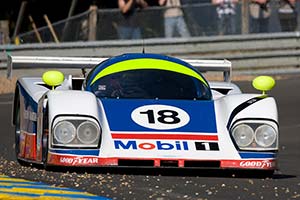
 Like many other small manufacturers, Aston Martin withdrew from racing in the early 1960s. The arrival of the big manufacturers and their massive marketing budgets made it virtually impossible for a company the size of Aston Martin to compete. A good example of this 'corporate racing' was the Le Mans effort of the Ford Motor Company, eventually resulting in four victories. Ran by John Wyer, Aston Martin's racing effort ended on a high, with a World Sportscar Championship and a victory at the 24 Hours of Le Mans in 1959.