
 Ultimatecarpage.com
> Events
Ultimatecarpage.com
> Events
 2026 Monaco Historic Grand Prix 2026 Monaco Historic Grand Prix
|
| Click here to save all images | Monaco Historic Grand Prix |
| | 2006 | 2008 | 2010 | 2012 | 2014 | 2018 | 2022 | 2024 | 2026 | |
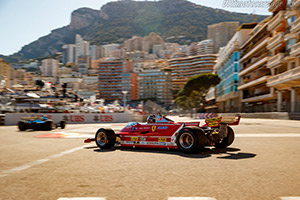 Had the Circuit de Monaco been located anywhere else, it would have long been deemed unsuitable as a venue for a Formula 1 World Championship Grand Prix. Many of the tight and twisty public roads used for the circuit have a 30 or 50 km/h speed limit for good reason on any other day, yet the prestigious Monaco Grand Prix has been a set fixture in the World Championship since its inception in 1950. In fact, the roads of the Principality were used for a Grand Prix for the first time in 1929. This long and rich heritage has been celebrated biennially from the late 1990s with the Grand Prix de Monaco Historique that uses the same roads as the World Championship scheduled a few weeks later. The event features eight different grids, split by age and covering the period 1929 through to 1985. New for the 2026 edition was the highly anticipated addition of turbo-engined cars to the final grid. During the lunch-breaks, the Ferrari Corse Clienti run Grand Prix cars were demonstrated. The session was preceded every day by Jacky Ickx, who was re-united with the strikingly beautiful Ferrari 312/68 F1, he had driven to victory in the 1968 French Grand Prix.
Our photographers explored the historic venue to capture the 15th Monaco Historic Grand Prix from start to finish with this class-by-class 180-shot gallery as the result.
Série A1: Pre-War Grand Prix Cars and Voiturettes
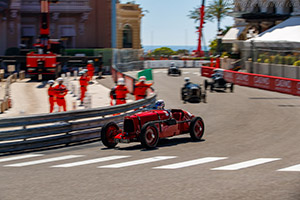 The inaugural Monaco Grand Prix was won by William Grover-Williams with a Bugatti Type 35 in 1929. Strictly speaking, it was not a Grand Prix yet as the race was run for the open 'Libre' category. Grover-Williams completed 100 laps on the streets of Monaco in just under four hours. The earliest category during the 2026 Historic Grand Prix only had to complete 10 laps but this still proved one too many for Richard Bradley. He was comfortably leading the race until his Maserati 4CL expired in the final corner. The victory instead went to an elated Patrick Blakeney-Edwards with his single-seater Frazer Nash.
Série A2: Pre-1961, front-engined Grand Prix cars
The first race of the weekend, scheduled at 8 am on Sunday morning, was for 1950s, front-engined Grand Prix cars. The field was a colourful mix of Maserati 250Fs, a Ferrari Dino, Lotus 16s, Coopers, Gordinis and more unusual machinery like a Scarab and the Lancia Aurelia powered Marino. Having beaten the opposition with a healthy margin in qualifying, Mark Shaw started from pole position with the Scarab. He had no issues in the race and won the race from Max Smith-Hilliard in a Lotus 16 and Guillermo Fierro in a Maserati 250F.
Série B: Mid-engined Formula 1 and Formula 2 cars
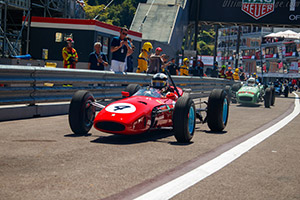 Mark Shaw was also in the mix for victory in Série B with his Lotus 21 Climax. He qualified second fastest behind Stuart Hall in a sister car and ahead of Joe Colosacco with the glorious Ferrari 1512 F1. It had been a difficult qualifying for the American as the Ferrari's clutch bearing had failed. With a spare part overnighted to Monaco, the Ferrari was ready to take on the two 21s. In the race, it was Hall who ran into trouble with gearbox issues. He had to keep the car in gear, so was forced to race with just one hand on the steering wheel. Hall nevertheless managed to hang on to third behind Shaw and Colosacco, who had a superb race and claimed his second Série B victory in the 1.5-litre twelve-cylinder engined Ferrari.
Série C: Front engined sports cars from 1952 to 1957
When it was announced that the 1952 World Championship would be run for Formula 2 cars due to a lack of a representative Formula 1 field, the Automobile Club de Monaco decided to run the 1952 Monaco Grand Prix for sports cars instead. To mark this one-off race, one grid is traditionally reserved for sports cars during the Monaco Historic Grand Prix. Qualifying was a two-way affair with Richard Wilson in a Maserati 250S and Fred Wakeman in a Cooper T38 Jaguar the only two drivers capable of running a sub two-minute lap time. They finished the race in the same order with Mathias Sielecki finishing a distant third in his ex-works Aston Martin DB3S.
Série D: Formula 1 cars from 1966 to 1972
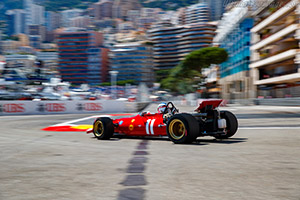 No fewer than four grids are reserved for Formula 1's 'three-litre' era, which ran from 1966 through to 1985. The dominant engine of this era was the Cosworth DFV V8 but there were exceptions, some successful like the Ferrari and BRM V12 and others less so like the BRM H16. Those very exotic BRM engines are only very rarely seen in action, let alone entered in a race. So Austrian enthusiast Jürgen Boden should be commended for bringing his BRM P83. He only ran the car in practice and then switched to his slightly less exotic Ferrari 312 B2 for the qualifying and the race. In qualifying, Monaco specialist Michael Lyons showed his skill by beating the nearest rival with a 2.3-second in his family's Surtees TS9. Lyons was also untouchable during the race and scored yet another win on the roads of the Principality.
Série E: Formula 1 cars from 1973 to 1976
Stuart Hall clinched his second pole position of the weekend with Yardley-liveried McLaren M23 in Série E. He had handsomely beat Lyons with a slightly later McLaren M26 in qualifying. Third was for another professional historic racer; Nick Padmore in a Lotus 77. Hall and Lyons put up a great show with Hall crossing the line in first. Lyons was entered in the invitational category, so his second spot on the podium was taken by Padmore with Guillaume Roman classified third in the one-off Ensign N175.
Série F: Formula 1 cars from 1977 to 1980
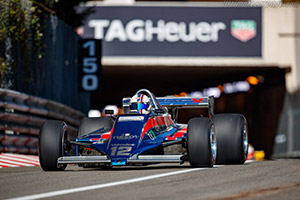 For the penultimate race of the weekend, it was once again Michael Lyons, who grabbed pole position but with a far smaller margin. Lyons was only three tenths of a second faster than Fred Rouvier, who made his debut on the streets of Monaco in a Tyrrell 010. Less than three hundreds of a second slower was Sam Hancock with a Fittipaldi F8. In the race, there was nothing either Rouvier or Hancock could do to prevent Lyons from scoring his second win of the weekend. They did, however, put up a fantastic show, running nose to tail throughout the race. Despite Hancock's best attempts, it was Rouvier who grabbed a well deserved second.
 Série G: Formula 1 cars from 1980 to 1985
Série G saw the return to the streets of Monaco of the mighty and revered 1.5-litre turbo cars. Although certainly not the ideal venue for these ferocious machines, several owners decided to bring a turbo car. For most, it was the very first race entry since the 1980s, so reliability proved an issue. Ramzan Urusbaev had the best run, finishing sixth in the Ligier JS25 that we had already seen in action at Estoril late in 2025. Shaun Lynn also did well to finish with the freshly rebuilt Lotus 95T that had been part of the Renault factory collection until November of last year. At the head of the field, it was Stuart Hall who scored a flag-to-flag victory with his March 821 that he had already driven to Série G victory back two years ago.
Final thoughts
Just like its modern equivalent, the Monaco Historic Grand Prix is among the most prestigious events on the calendar. Many enthusiasts buy an eligible car just to be on the grid but being competitive is a whole different matter. It is no coincidence that the likes of Stuart Hall, Michael Lyons and Joe Colosacco were back on the top spot of the podium. Both the great skill demonstrated behind the wheel by these drivers and the many very special cars on the grid have made the Monaco Historic Grand Prix the unmissable spectacle that it is today. We spent the weekend exploring all the legendary corners, the paddock and the unique pit lane to capture the 15th Grand Prix Historique in this 180-shot gallery.
Report by Wouter Melissen and images by Wouter Melissen and Pieter Melissen for Ultimatecarpage.com
| All Cars - Contact us - Privacy Statement - Top | © 1998 - 2026 Ultimatecarpage.com |