
 Ultimatecarpage.com
 News archive News archive
|
News Archive
| 2026 | 2025 | 2024 | 2023 | 2022 | 2021 | 2020 | 2019 | 2018 | 2017 | 2016 | 2015 | 2014 | 2013 | 2012 |
| December | November | October | September | August | July | June | May | April | March | February | January |
2026-06-11: News round-up with Audi Nuvolari and manual BMW M3 ...
 During the Monaco Grand Prix, Audi revealed the all-new Nuvolari. Named after the legendary Italian racing driver Tazio Nuvolari, it is not a successor to the R8 but the very first Audi hypercar. Power comes from a twin-turbo V8 that is assisted by three electric motors with a combined output of 1,001 metric horsepower. In good Audi tradition, an aluminium space frame chassis is used but clothed in a carbon-fibre composite body for the first time. Production of the 350 km/h Nuvolari is strictly limited to 499 examples with the first deliveries expected early in 2027.
BMW North America will sound out the production of the sixth generation M3 with this very special M3 CS Handschalter. As the name suggests, it is fitted with a six-speed manual gearbox instead of the eight-speed automatic found in the other M3 models. Rear-wheel drive only, the M3 CS Handschalter has a base price of $107,100. Replacing the original launched in 2022, Rolls-Royce have revealed the Spectre Series II. As before, it is electric only and now has a range of well over 600 km. In addition to the standard model, Rolls-Royce also offers a 'Black Badge' version that has a slightly more powerful drivetrain. Toyota's motorsport subsidiary Gazoo Racing has reworked the popular Corolla hatchback to create the GRMN Corolla. Slated as the ultimate GR Corolla, it combines a 300 bhp engine with a six-speed manual gearbox and all-wheel drive. Sadly, the GRMN Corolla will be produced in limited numbers and will only be available in Japan, Australia and North America. |
2026-06-04: Rare Ford GT40, Le Mans Corvette and DB4 GT Zagato offered for sale ...
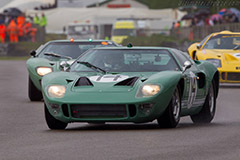 Broad Arrow Private sales have been entrusted with this very early Ford GT40, which is offered from a single ownership of over 30 years. It was entered at Le Mans in 1965 by Ford Advanced Vehicles and was the first sport the definitive nose shape. It was later also used for extensive testing before it was sold. In subsequent ownership, it was loaned to the Midland Motor Museum before the current custodian acquired GT40P/1006 in 1993. We captured it at a very rare public appearance at the 2013 Goodwood Revival where it was raced by Henri Pescarolo in the Whitsun Trophy, which was reserved exclusively for Ford GT40s.
Another Le Mans car that has made headlines over the last few years is this Chevrolet Corvette from 1960. It was entered at Le Mans that year by Briggs Cunningham and then changed several times before it disappeared from view in 1974. Fast forward to 2021 when it was acquired at auction in rather derelict condition by the Cunningham family. They had the ex-Le Mans comprehensively restored to its original configuration. Chassis 00867S103535 was then shown a variety of events. It is now consigned to the upcoming RM Sotheby's Monterey sale with a $2 - $2.5 million estimate. Also consigned to the Anglo-Canadian company's flagship auction is this very rare Aston Martin DB4 GT Zagato. One of just 19 built, this was the only one sold new to Australia. It remained 'Down Under' for three decades and in more recent years has been part of two prominent American collector. Regularly shown at events, DB4GT/0186/R was one of the four nominees of the coveted Pebble Beach 'Best of Show' in 2019. Due to be one of the absolute star cars, the DB4 GT Zagato should sell for well over $12 million. |
|
2026-06-02: 2026 Monaco Historic Grand Prix report and 180-shot gallery ...
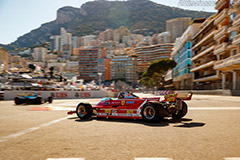 This weekend, all eyes will be on Monaco for the annual Formula 1 Grand Prix. We already visited the Principality earlier this year to capture the 15th edition of the Monaco Historic Grand Prix. The biennial event celebrates the rich history of the most prestigious Grand Prix on the calendar. It uses the very same challenging street circuit and is open to competition cars of a type that raced at Monaco between 1929 and 1985. The entry list is split in eight different grids with seven reserved for Grand Prix cars and the eighth to celebrate the unique 1952 Monaco Grand Prix that was run for sports cars. New for this year's edition was the addition of turbo-engined cars to the final grid on the roster. Even though only one had been used for historic racing, and only once, five of the highly anticipated turbo cars were entered. Among the other stand-out cars were the very rare H16-engined BRM, the one-off Lancia Marino and the 1968 French Grand Prix winning Ferrari 312/68 F1 that was reunited with its original driver Jackie Ickx for demonstration runs. At the sharp end of the fields, there was some fantastic racing as the tight and twisty track really requires a skilled hand.
As always, we explored the streets of Monaco to capture the event in its entirety. The result is this detailed report and class-by-class 180-shot gallery. |
2026-05-28: All-new Ferrari Luce, Mercedes-AMG GT and most powerful Emira yet ...
 At a special earlier this week, Ferrari revealed the all-new Luce. The very first all-electric Ferrari represents a break with tradition in more ways than one. It was styled by industrial designers Jony Ive and Marc Newson, who started with a clean slate. Underneath the striking body panels, the Luce is also a technological tour de force with 60 patents filed during the engineering process. It features electric motors in each of the four wheels for a combined power of 1,035 bhp. Created to appeal a new niche of the market, Ferrari's four-door battery electric vehicle is priced at well over $600,000.
With 1,153 bhp maximum power output, the latest Mercedes-AMG GT 63 4-Door Coupe boasts similar figures as the Luce. This power is produced by three electric motors, one on the front axle and two on the rear. The four-door coupe also has futuristic styling with a particularly interesting rear-end. Compared to the other two cars announced this week, the Lotus Emira 420 Sport is refreshingly old-school. Powered by the familiar turbocharged Mercedes-AMG four-cylinder engine, it is both more powerful at 414 bhp and 25 kg lighter than the existing Emira models. The Emira 420 Sport also introduces a removable hard-top that will be available as an option on the complete Emira range. |
|
2026-05-21: 2026 Goodwood Members' Meeting report and 150-shot gallery ...
 Goodwood kicked off the busy 2026 motorsport season with the 83rd Members' Meeting earlier this year. A relatively recent addition to the calendar, it is a more laidback event that still uses the iconic Goodwood Motor Circuit but without the strict cut-off dates of the Revival. The two-day meeting combines a series of races with high-speed demonstrations. Among the many highlights on the roster this year were the two-driver Protheroe Cup for earlier Jaguar E-Types and the two-driver Gordon Spice Trophy for big banger touring cars. These races see owners joined by celebrity drivers that included the likes of Dario Franchitti and Jenson Button. The latter was also out in the Brawn Formula 1 car that he used to win the 2009 World Championship. The two other chassis used that year were also in the paddock, marking the first time they were together since that fabulous season. Additional demonstrations featured the iconic Super Touring cars of the 1990s and a celebration of the 50th anniversary of James Hunt's 1976 Formula 1 World Championship.
Enjoying the lovely spring weather, we were on hand to capture the 83rd Goodwood Members' Meeting from start to finish. The result is this concise report, illustrated by a class-by-class 150-shot gallery. |
2026-05-18: One-off Ferrari and Zonda, new Koenigsegg engined Kimera and BMW Vision Alpina ...
 Over the weekend, Ferrari introduced the HC25, which is the latest one-off model produced by the Italian manufacturer. It is based on the F8 Spider and features styling by the recently introduced F80 hypercar. Like the base vehicle, the HC25 boasts a non-hybrid twin-turbo V8, which is good for over 700 bhp.
The latest car to emerge from Pagani's Unico department is this Zonda Cervino. It was launched at Saturday's Fuori Concorso in Como and boasts bespoke, restyled bodywork. Strictly a one-off, the Cervino was based on an existing Zonda chassis and was modified specifically for a discerning customer. Italian specialists manufacturer Kimera has collaborated with Koenigsegg and Dallara to create the truly wild K39. Underneath the retro, Lancia-inspired skin sits a Koenigsegg twin-turbo V8 engine that produces in excess of 1,000 bhp. In addition to the road-going Stradale, Kimera will also produce a wilder still Pikes Peak version to compete in the legendary race to the clouds. At Villa d'Este, BMW provided a glimpse at the future of the Alpina brand with the Vision Alpina. Now a wholly owned subsidiary, Alpina looks to produce standalone models using BMW underpinnings. |
|
2026-05-15: Ferraris due to cross the Broad Arrow Auctions block this weekend ...
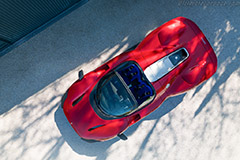 Broad Arrow Auctions will stage the official Villa d'Este sale this weekend. The two-day auction includes this striking Ferrari Daytona SP3. One of just 600 produced, it was finished in a classic red over blue and delivered new to Andorra in 2023. Having covered a mere 743 km from new, chassis 286921 is now estimated to sell for €6,500,000 - 8,500,000.
Also due to have been part of this sale was this Ferrari Monza SP2 with a distinct three-tone finish. Also in virtually brand-new condition, chassis 261538 has actually already found a new owner before the sale. In addition to the in-person auction during the Concorso d'Eleganza Villa d'Este, Broad Arrow also stages the 2026 spring edition of the Global Icons online-only sale. The absolute headliner is another Ferrari; this LaFerrari. Painted in an unusual 'Fuji' white, it has been fastidiously maintained but only used very sparingly. In fact, Broad Arrow reckons 214333 ranks among the LaFerraris with the lowest mileage. Accordingly, the pre-sale estimate is $4,250,000 - 4,750,000. |
2026-05-12: New Lamborghini few-off and Super Trofeo, and Golf and Renault show cars ...
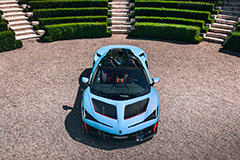 During the dedicated Lamborghini Arena event this weekend at Imola, the Italian manufacturer debuted the new Fenomeno Roadster and the Temerario Super Trofeo. Powered by a 1,080 hp V12 hybrid drivetrain, the Fenomeno Roadster is the latest 'few-off' model produced by Lamborghini. Like the Coupe model introduced in 2025, the Roadster has a limited production run. In this case only 15 examples will be produced and all of these are undoubtedly already spoken for.
The Temerario Super Trofeo is Lamborghini's new weapon for the Italian company's popular one-make trophy. It was jointly developed with the GT3 version that debuted earlier this year at the Sebring 12 Hours. Power comes from a twin-turbo V8 that is mated to a six-speed sequential gearbox. The Temerario is due to compete in the Super Trofeo events from the 2027 season onwards. That year, Volkswagen plans to run the Golf R in the Nürburgring 24 Hours. To give a first impression what we can expect on the grid in twelve months time, VW created this Golf R 24H Show Car. The car due to be raced by Max Kruse Racing in 2027 should be very similar to this year's show car. At the prestigious Rolland Garros tennis tournament in Paris, Renault will unveil this funky 4 JP4X4 Concept. Based on the recently re-introduced '4' and inspired by the JP4 of the 1980s, it is a cross between a pick-up and a beach buggy. |
|
2026-05-04: New McLaren Hypercar and most powerful Morgan yet ...
 McLaren today revealed the MCL-HY, which will compete in the FIA World Endurance Championship from the 2027 season onwards. Built to the LMDh regulations, the new McLaren hypercar has been created together with partner Dallara. The carbon-fibre rolling chassis is clothed with bespoke McLaren bodywork and powered by a hybrid drivetrain that consists of a McLaren twin-turbo V6 and a spec Bosch hybrid system. The MCL HY is currently under development and will be raced in Can-Am inspired livery by the United Autosports team.
In addition to the works hypercar, McLaren also showcased the MCL-HY GTR derivative. Currently offered to McLaren's VIP customers, the track-day only machine uses a simplified version of the drivetrain that uses a slightly more powerful version of the twin-turbo internal combustion engine. With first deliveries due in 2027, McLaren plans to produce around 30 to 35 examples of the MCL-HY GTR. Morgan has expanded the Supersport range with the new Supersport 400. True to its name, it is the first Morgan production road car that boasts over 400 bhp. This is produced by the BMW-sourced straight-six engine. Available to order now, the Supersport 400 is priced at £112,965. |
2026-04-23: Track-only Bugatti and Lamborghini headed for auction ...
 For this weekend's Monaco sale, RM Sotheby's has consigned a pair of track-only hypercars. Offering the most impressive performance is this Bugatti Bolide. One of 40 built, this example was equipped with €291,000 worth of options, which included the two-tone exterior finish. Since taking delivery of the car in 2024, chassis 004 was used only sparingly and is now estimated to sell for €3.5 - €4.5 million.
From the same family comes this Lamborghini Essenza SCV12. Also limited to 40 examples, the Essenza features a 830 bhp V12 engine and can be run as part of a special Lamborghini Corse programme. The example consigned has seen some use and should find a new owner for €1,200,000 - €1,800,000. We are also in the Principality to cover the biennial Monaco Historic Grand Prix from which an in-depth report will follow shortly after the event. |
|
2026-04-21: Striking Porsche 918 Spyder and rare Porsche CK5 headed for auction ...
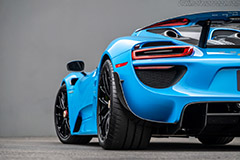 At the upcoming Porsche Air|Water event in Cosa Mesa, California, Broad Arrow Auctions will stage the official sale. Consigned as the headliner is this low mileage Porsche 918 Spyder. It was finished in a very distinct Paint to Sample Riviera Blue, which is inspired by the fabulous French Riviera coast. It was also equipped with the desirable Weissach Package and removable carbon-fibre composite roof panels. Chassis 048 is now estimated to sell for $4.5 - $5.5 million.
Another interesting car on the lot list is this Kremer CK5 Group C racer. The CK5 was built by the legendary Kremer brothers to compete at Le Mans, awaiting the arrival of the customer version of the Porsche 956. It was constructed around a 936 inspired chassis, using existing Porsche components from the 935 and 917. The example on offer this weekend is the second chassis constructed, which was raced at Le Mans in 1983. It continued to be raced through to 1985 and was later owned by Walter Wolf and Freisinger Motorsport. Now once again boasting its Le Mans livery, the beautifully preserved machine has recently been shown at several events but has not yet seen action in historic racing. |
2026-04-16: First-ever 911 GT3 convertible, new coach-built Rolls and one-off Pagani ...
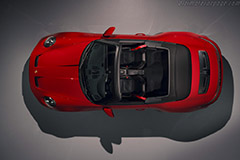 For the first time ever, Porsche has produced a convertible version of the hardcore 911 GT3 model. Known as the 911 GT3 S/C, the 992 II generation machine shares its underpinnings with the GT3 and has a similar specification as the acclaimed Touring version. Despite the addition of a fabric foldaway roof and structural reinforcements required to maintain rigidity, the 911 GT3 S/C still tips the scales at under 1,500 kg. It is also available with the optional Street Style Package that includes special graphics.
Rolls-Royce has launched the new Coachbuild Collection programme with the Project Nightingale. Based on the British company's battery-electric platform, it features a bespoke convertible design with smoother lines than the 'regular' Rolls-Royce production models. Although close to six metres in length, the two-door Project Nightingale seats only two passengers. To headline the upcoming flag-ship Villa d'Este Auction, Broad Arrows has consigned this one-off Pagani Zonda 760 Unica Roadster. This fittingly named model was built for a discerning customer in 2018. It has since been regularly shown in events and actually covered a commendable 2,617 km during this period. The American auction company estimates the Unica Roadster should find a new owner for at least €9.5 million. |
| All Cars - Contact us - Privacy Statement - Top | © 1998 - 2026 Ultimatecarpage.com |