2024-04-25: Mullin Automotive Museum auction and latest news ...
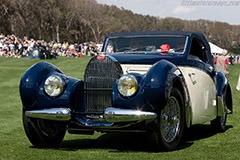
Shortly after the passing of founder Peter Mullin, the marvellous Mullin Automotive Museum closed its doors. A large part of the collection will be offered this weekend at a dedicated
Gooding auction at the museum. Among the highlights of the selection consigned are this
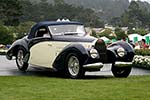
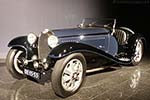
Bugatti Type 57 C Gangloff Aravis Cabriolet that was originally sold to French racing driver Maurice Trintignant and the
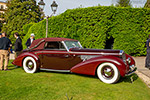
Delage D8-120 Chapron Cabriolet that starred alongside Gene Kelly in the movie
An American in Paris.
At the Auto China Beijing motor show, Lamborghini revealed the
Urus SE. It is the first hybrid version of the popular Lamborghini SUV and combines an internal combustion engine with an electric motor that is mounted inside the gearbox. The maximum power produced by the hybrid drivetrain is 800 bhp.
Also launched this week are updated versions of the
Porsche Cayenne GTS, the
Porsche Cayenne GTS Coupe and the
Mercedes-AMG GT 63 S E Performance.
2024-04-22: 2024 Mugello Classic and 200-shot gallery ...
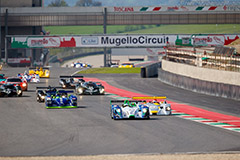
The European historic racing season got under way a fortnight ago with the third annual
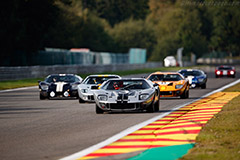
Mugello Classic. Staged by the Peter Auto organisation, the event saw two new grids compared to the previous years with the Classic Touring Challenge for Pre '60s touring cars and the Gentlemen Challenge for 1950s and early 1960s machinery added to the roster. These joined the familiar grids, with the capacity Endurance Racing Legends field taking centre stage. Headlined by Emanuel Collard reunited with his Pescarolo Courage C60, the grid also boasted a trio of Maserati MC12s, a pair of Bentley Speed 8s, an Audi R8 and a Lotus Elise GT1.
With spring in the air and great grids, the Mugello Classic proved to be more than fitting start to the 2024 racing season. We were on hand from start to finish to capture the event in its entirety, the result is a
concise report, illustrated by a class-by-class
200-shot gallery.
2024-04-19: RM Monaco preview with Gulf Aston Martin and drop-top Ferraris ...
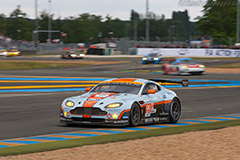
Anglo-Canadian auctioneer RM Sotheby's have revealed the full lot list of the two-day
Monaco sale. Due to be held during the Grand Prix Historique weekend, the auction has some fascinating consignments. Among them is this
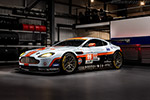
Aston Martin V8 Vantage GT2, which was the original factory development car for the ten production cars that followed. It was raced in its original guise at select events during 2008 and 2012. Chassis
V8 X2 did not appear at Le Mans until 2012, proudly wearing the Gulf works colours. It has recently been restored to its 2012 configuration and is ready to go.
With a €4.5 - €5 million estimate one of the absolute headliners of the sale is this
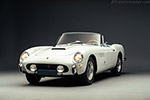
Ferrari 250 GT Cabriolet. Originally finished in ivory white with a turquoise interior and covered headlights, it was sold to an Italian enthusiast. It was subsequently sold to France where the engine was damaged and replaced. At some point, it was also re-painted black. In more recent years,
0849GT was re-finished to its original colours and re-united with its original engine.
Another open Ferrari available in the principality is this
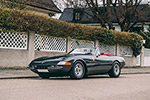
365 GTS/4 Daytona. It was also delivered new to Italy where it remained for some years before a lengthy spell in the United States. Repatriated to Europe in the early 2010s,
15383 was then entrusted to a cosmetic restoration. In German hands since 2017, it is now estimated to sell for around €3 million.
2024-04-17: Latest Italian sports car news from Abarth, Maserati and Lamborghini ...

Celebrating Abarth's 75th anniversary, Stellantis have assembled a great collection of classic models in the Heritage Hub. Guest of honour is a 1:3 scale-model of the
Abarth Classiche 1300 OT, which will enter very limited production later this year. Only five examples will be constructed of the compact sports car that is inspired by the original 1300 OT competition car and is based on the Alfa Romeo 4C platform. The
Classiche 1300 OT is now available to order.
Maserati have completed the GranCabrio line-up with the all-electric
Folgore version. Although no figures have been released, the drop-top battery-electric vehicle should share the same 751 bhp as the previously introduced GranTurismo Folgore. According to Maserati the
GranCabrio Folgore represents the company's voice of the future.
Lamborghini will soon phase out the Huracan but not before producing a small run of
STJ models. Powered by a 630 bhp version of the glorious V10 engine, which will also be phased out, the STJ was developed together with Lamborghini Squadra Corse. The name is short for Super Trofeo Jota and accordingly, the STJ features a more aggressive aero package and track-oriented Bridgestone tyres. Lamborghini will only build ten examples of the
Huracan STJ, before permanently closing the book on the Huracan.
2024-04-10: 81st Goodwood Members' Meeting preview with Shadow, Ferrari and Porsche ...
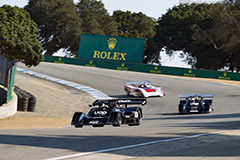
This weekend we will make the first of three visits to Goodwood of the year for the 81st Members' Meeting. Among the highlights this year will be the high-speed demonstration. Taking a very loud centre stage will be legendary Can-Am racers. Central part of the line-up will be a collection of Shadow racers that have been shipped over especially from the United States. Among them is the very
DN4 driven to four victories and the title in the final Can-Am season. The mighty racer is powered by a big block V8 good for at least 800 bhp.
DN4-1A was retained for many years by Shadow founder Don Nichols and was only restored to full running order in the mid-2010s.
The other demonstration run will see Gerhard Berger reunite with the
Ferrari 640 F1 that he raced during the 1989 Formula 1 World Championship. The Austrian campaigned the car during five Grands Prix but with little luck. In recent years, chassis
110 has already seen action at Goodwood, during the Festival of Speed in 2019 and again in 2022.
At last year's
Members' Meeting the 60th anniversary of the Porsche 911 was celebrated with a demonstration of 911-based competition cars. The Porsche Museum brought out the spectacular
911 Carrera Turbo RSR, which is 50 years old this year. The ex-works racer served to develop the 911 Turbo road car and was subsequently developed into the 934 and 935.
2024-04-04: Mugello Classic preview with Maserati MC12 and Dallara SP1 ...
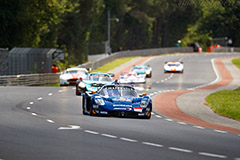
This weekend we are in the flowing Tuscan hills for the Mugello Classic. Organised by Peter Auto, the event features a capacity grid for the Endurance Racing Legends. The field of 1990s and 2000s sports racers is not just Porsche 911 derivatives but boasts a breadth and depth that is quite spectacular. To get you in the mood we have taken a closer look at two cars that are exemplary for the field. First up is this
Maserati MC12 Corse, which is one of three entered this weekend. It was originally raced by the JMB team and finished second in the 2005 Spa 24 Hours. It was subsequently raced in the Citation Cup for gentleman drivers. Restored to its original configuration, chassis
008 will now be raced by another gentleman racer, who competed with a sister car in period.
The MC12s will be joined by this Judd V10-engined
Dallara SP1. The sixth and final chassis built, it was originally fielded by the Playstation Team Oreca at Le Mans in 2002. Starting fourth, it eventually finished sixth. It then sat for two years, before it was campaigned by Martin Short's Rollcentre Team. Retained for many years by Short,
DO-006 still sports Rollcentre colours but is now under new ownership.

 Ultimatecarpage.com